Teaching
Alex’s 10 years of teaching experience across Penn State, Weber State, and the University of Utah includes 12 undergraduate courses and 4 graduate level courses. She has contributed to curriculum development in two NAEYC- accredited early childhood professional preparation programs and has developed undergraduate and masters- level coursework aligned with Infant Mental Health Endorsement® competencies. She also taught a History seminar in Psychoanalysis & Culture at the Honors undergraduate level. Click the title of each course below to view course information including descriptions, formats, assessment, and alignment with professional competencies.
Infant and Early Childhood Mental Health (FCS/ PSY 3300, University of Utah)
This course provides an introduction to the field of infant and early childhood mental health. The early years are a time when children are most vulnerable to psychological harm, but also most receptive and “plastic” to positive interventions. This course will allow students to uncover developmentally relevant risk factors and learn more about how early life stress and trauma can impact biopsychosocial development in infancy and early childhood. Specifically, we will review the impacts of parental psychopathology, early life stress, structural barriers, and other risk factors on caregiver-child interactions and child development. Students will be able to articulate how early life stress and exposure to parental psychopathology “get under the skin” to affect behavioral and mental health outcomes. We seek to understand how experiences, both positive and negative, during infancy, toddlerhood, and the preschool years become building blocks for future well-being. We will also consider the applications of these concepts to mental health promotion, prevention and intervention. We will consider intervention such as home visiting and early childhood therapeutic approaches and parent- child psychotherapy. We will also examine policy solutions to infant and early childhood mental health issues. This course is offered in Hybrid and Face- to- Face formats.
Introduction to Early Childhood Education (ECE 451, Penn State)
As one of the introductory courses to early childhood education for undergraduate students, this class presents a foundational base of the early childhood education field, including the study of children/childhood, current practices, various roles of practitioners, environments for learning, and approaches to teaching. This course provides an historical overview of influential thinkers and the roots of early childhood education, multidisciplinary perspectives of development of the young child (for example, perspectives on children/childhood from anthropology, behaviorism, developmental psychology, neuroscience, postmodernism and post-structuralism, psychoanalysis, etc.), and resources for planning curriculum and instruction.
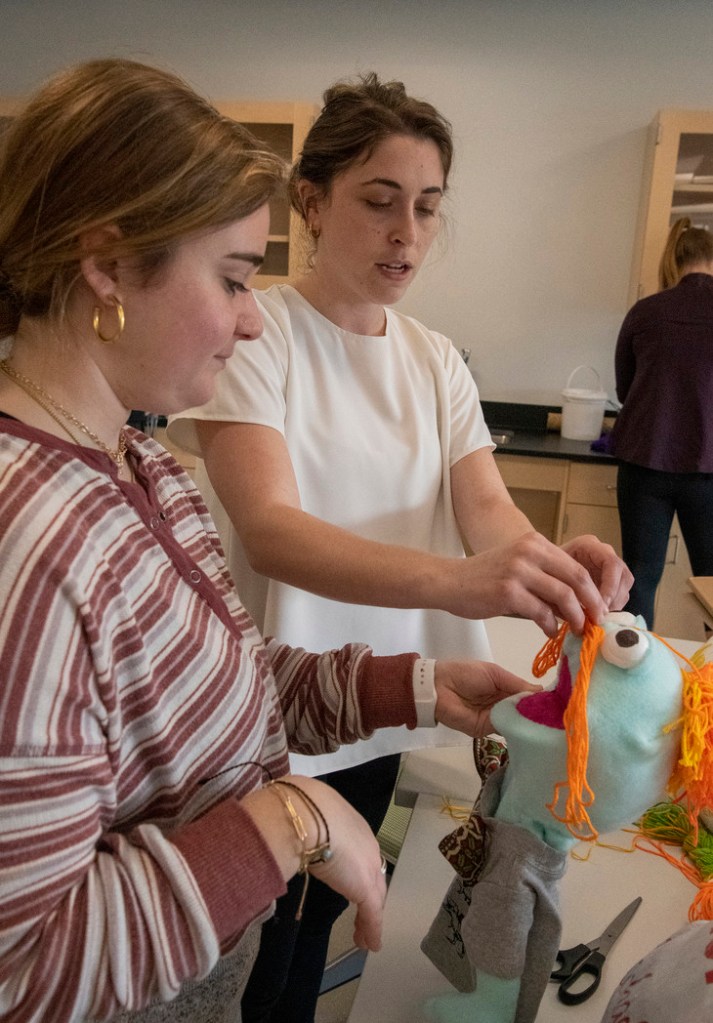
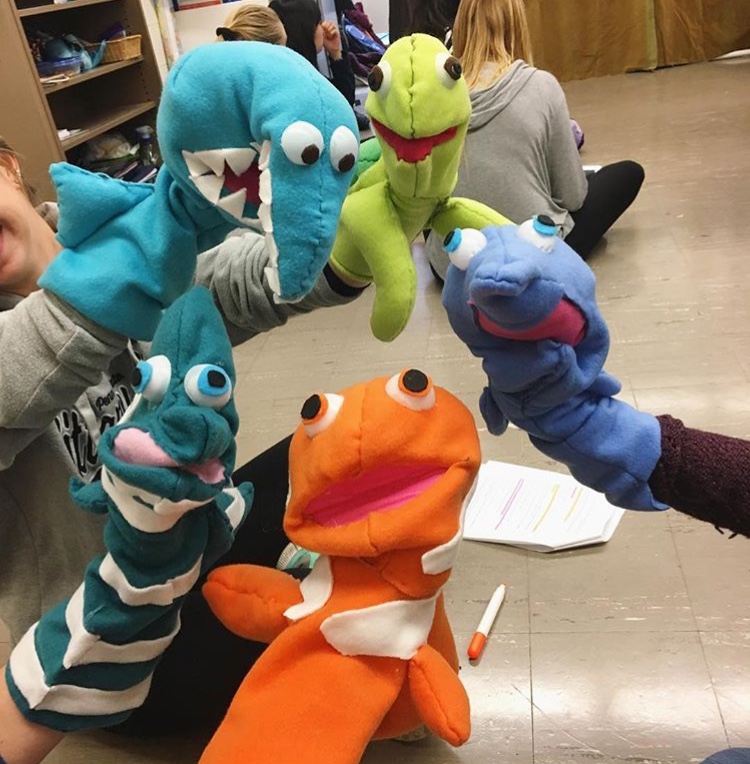
This course involved a semester-long service learning project informed by Sesame Street, where students sewed puppets and wrote scripts around a theme of inclusion. Through community partnerships that Alex built over five years’ time, students performed these shows at six different schools including campus childcare centers, a Montessori program, a Quaker program, a Lutheran program, and a public elementary school.
This course, required for PK-4 licensure in Pennsylvania, was aligned with NAEYC Professional Standards and Competencies and included a Key Assessment.
The Young Child’s Play as Educative Processes (ECE 479, Penn State)
This course covers concepts and uses of play in education based on theory, research, and teacher experience. Philosophical bases are explored in defining and articulating educational play and its learning and developmental benefits. Teacher roles and methods of curricular networking to academic content areas as well as assessment and documentation strategies and the role of technology and teacher advocacy are examined. Classroom applications related to the pedagogy of play and outdoor play and recess are included for preschool and primary grades.
This course, required for PK-4 licensure in Pennsylvania, was aligned with NAEYC Professional Standards and Competencies.
Introductory Field Experience for Early Childhood Education (CI 295a, Penn State)
This course is intended to provide students with guided experience as participant observers of young children in a group setting. Students will gain this experience within campus and community based early childhood settings. In this course we will consider observation as an art and a form of pedagogy in early childhood settings. We will inquire as to how the teachers in our placements use observation to inform their practice of teaching and planning curriculum and how it relates to child assessment. We will use our observations to view the powerful role of the environment and how teacher’s interactions are critical to early learning. We will observe play as the primary means of learning for the young child. We will consider the importance of being fully present with children in order to really see their unique perspective on the world. Our goal is to support students’ own exploration of early childhood theory and practice through immersion in the world of the young child.
This course, required for PK-4 licensure in Pennsylvania, was aligned with NAEYC Professional Standards and Competencies.

Educational Ethnography: History, Theory, and Methods: co-taught doctoral seminar (CI 597, Penn State)
This seminar shows students how to use ethnographic methods for education research to inform classroom practice and education policy. The course is centered around the idea that school communities serve as key sites for students of all ages to learn to become members of their culture(s). Course readings include historical to contemporary works of researchers who have shaped educational ethnography. We will also read about education in various settings and discuss anthropological explanations of inequities experienced by minority culture communities or marginalized groups. Students will carry out a mini-ethnographic study based on their area of research interest. The course is especially designed for students to be able to conduct ethnographic studies or make use of ethnographic techniques in future research projects.
Theories of Childhood: Teaching Assistant (CI 560, Penn State World Campus)
“There is no child independent of race, ethnicity, social class, gender, religious beliefs, cultural and subcultural membership, and history. All children are ancestrally and sociohistorically located” (O’Loughlin, The Subject of Childhood, 2009, p. 26).
In this course, we will explore the highly variable ways that childhood has been constructed and enacted across multiple cultures and throughout history. We will begin by considering how notions of the nature of childhood—for example, children as innocent, as primitive, or as blank slates—have functioned across history and in our own memories and sense of nostalgia about childhood. We will expand our understanding of historic and contemporary childhoods through comparative studies of children. We will finish with an examination of contemporary child culture, including play and how changes in global culture affect children’s lives.
Inclusive Early Childhood Curriculum (ECED 4620, Weber State)
Critical issues, theories, research, and practice in curriculum for inclusive early childhood education. The goal of this course is to assist students in planning, implementing, and evaluating curriculum that is accessible and culturally sustaining for diverse children and families. Students will be challenged to develop and articulate their own philosophies on what should be taught to young children and why. This course is aligned with NAEYC Professional Standards and Competencies and the Utah Effective Teaching Standards, and has a particular emphasis on citizenship education.
Alex developed this as a new course for Weber State University. This class was taught in face-to-face hybrid format and involved individually designed semester-long inquiry projects.
Understanding Children Beyond Behavior (ECED 4220/ GSE 6220, Weber State)
This course provides a foundation for understanding and engaging with children’s behavior and needs in school, home, and community settings, toward new and relational understandings of children, child development, and difference. While studying theories and research from fields of neuroscience, psychoanalysis, Disability Studies in Education, and critical perspectives in early childhood education, students will practice therapeutic techniques for observation and engagement with children and families. This course is aligned with NAEYC Professional Standards and Competencies and the Infant Mental Health Endorsement® (IMHE®) competencies.
Alex developed and taught this as a new course for Weber State University. This class was taught in virtual, hybrid format, and involved individually designed semester-long inquiry projects. This course was offered at the undergraduate (ECED 4220) or graduate (GSE 6220) level.
Child Observation Seminar (Psychoanalytic Work Discussion Group) (ECED 4820/ GSE 6820, Weber State)
The Child Observation Seminar is a small group reflective practice seminar. Students meet weekly to view and discuss video clips from work with young children in school, home, or community settings. Groups are facilitated to support early childhood professionals in feeling and awareness in their subjective emotional present, toward new experiences of themselves with children, families, and fellow early childhood professionals that may transform their work. This course is grounded in practices of psychoanalytic infant observation and Work Discussion from the Tavistock tradition, and video-cued ethnographic interviewing. This course is aligned with NAEYC Professional Standards and Competencies and the Infant Mental Health Endorsement® (IMHE®) competencies.
Alex developed and taught this as a new course for Weber State University. This course was taught in face- to- face format.
Psychoanalysis and Culture (Honors seminar; HIST 4720: Special Topics and Issues in European History, Weber State)
Established as a revolutionary theory of the mind by Sigmund Freud and a small group of his followers more than a century ago, psychoanalysis has continued to find useful application as a rich interpretive methodology for students of culture, politics, art, history, and identity. Today, psychoanalytic concepts are as likely to be employed by scholars of culture as they are by clinical psychotherapists. But what exactly is psychoanalysis? What makes it unique among other approaches to human psychology and other methods of interpretation? What novel insights does it provide into the nature of the self and the shared forms of human experience and meaning manifested in culture? This course will provide answers to these questions by surveying psychoanalysis through its history, theories, and applications. The course will culminate with a consideration of the ways in which scholars have put psychoanalytic ideas to use in understanding different cultural phenomena such as gender, race, class, sexuality, disability, religion, and political ideology.
Alex developed and taught this as a new course for Weber State University, in collaboration with Dr. Brady Brower. This course was taught in face-to-face format.
Educational Psychology, Child Development, and Classroom Management (ECED/ EDUC 3145, Weber State)
This course examines historical and contemporary perspectives in educational psychology, child development and guidance, and classroom management for kindergarten through 8th grade, with a focus on translating theory to practice within diverse communities of learners. This course was aligned with NAEYC Professional Standards and Competencies and the Utah Effective Teaching Standards.
Alex developed and taught this as a new course for Weber State University in collaboration with Sara Gailey, M.Ed.
Development of the Child (ECED 2500, Weber State)
This course examines contemporary theory and research of growth and development from conception through childhood, studied in the context of family, gender, culture, language, disability, socioeconomics, diversity, and society. Alex has taught this course in face-to-face and asynchronous online formats, for full semester as well as 7-week blocks.
This course is aligned with NAEYC Professional Standards and Competencies and the Infant Mental Health Endorsement® (IMHE®) competencies.
Language Development and Emergent Literacy in Early Childhood (ECED 4130, Weber State)
This course explores current theory, research, and evidence based practices for promoting early language and emergent literacy development (birth 8 years) in home, child care, prekindergarten, and primary education environments through collaborative practices between early childhood professionals and parents. Alex has taught this course in face-to-face and virtual hybrid formats.
This course is aligned with NAEYC Professional Standards and Competencies.
Curriculum Planning for Kindergarten (CHF 3620, Weber State)
Presents a foundational base for planning curriculum in kindergarten, including the design of learning environments and curriculum that are developmentally appropriate and “evidence based”, as well as an introduction to critical and reconceptualist approaches to early childhood curriculum. This course prioritizes observation and understanding young children as the foundation for all curriculum and pedagogy. Alex has taught this course in face-to-face and virtual hybrid formats.
This course was aligned with NAEYC Professional Standards and Competencies and the Utah Effective Teaching Standards.
Alex also taught a semester-long Guided Readings independent study course in inclusive early childhood education (Weber State).
She has also supported local early childhood professionals by preparing Concurrent Enrollment instructors to teach Child Development (ECED 2500) in local (Utah) high schools.
During the COVID-19 pandemic and in response to the longstanding needs of non-traditional students, a primary focus in her teaching has been developing accessible online learning materials. During her first two years at Weber State, Alex was awarded nearly $30,000 of university-level funding to lead the development of online coursework and practicum opportunities in early childhood education.
Alex is also experienced in revising undergraduate educator licensure programs and in graduate program and certificate development, having led the development of a new master’s program in inclusive early childhood education. As part of the graduate program proposal, Alex developed 5 new courses along with practicum opportunities in early childhood education and in supervised college teaching.
 Alex Collopy Rosenwald, Ph.D.